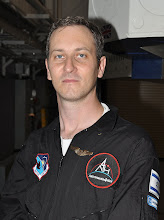
Getting ready to go underwater. Credit: Guillaume Fortin
Complacency... When one thinks about aircraft crash landing, be it an airplane, a helicopter or maybe a suborbital spacecraft, that's not the word that usually comes to mind. On November 19 I drove up from my home in Issaquah WA to Langley BC in order to learn why it is enemy number one when the craft or pilot fail and how to escape a drowning airplane the right way (i.e. alive).
One week in March I got to live a bit of my space aspiration. No, I didn't go to space (I continued to ride spaceship Earth). What I did was to go through two segments of commercial astronaut training. After AGSOL near Boston it was time for NASTAR near Philadelphia. Over three days I went up to a simulated 25,000ft altitude in a hypobaric chamber and went on simulated flights that exposed me to real 3.5Gz, 6Gx and most exciting of all, a virtual ride on SpaceShipTwo.
NASTAR is a place that trains many types of people, from fighter jet pilots to aspiring astronauts and space tourists. Over the past five years, after being spun-off of a manufacturing facility for centrifuges, altitude chambers and simulators, it formed several training programs around suborbital flight. The one I went through with seven other men and women was Suborbital Scientist Training, meant for people who will not only go to space as tourists, but will actually need to function in the few minutes of weightlessness rather than just admire the view. My plan B is to win the lottery...
An astronaut and a friend of mine shared a similar experience about twenty years apart...
When you're a budding violinist getting ready for an important recital you practice, then practice and then practice some more. To achieve the level of perfection that is needed to play the violin, knowing the notes by heart is not enough. Your muscles, ligaments, fingers and soul have to become one with the piece you play, so you invest a lot of time towards those crucial few minutes of performance. At some point, especially close to the big day, you may want to take a break from practicing and do something else to take the edge off the tension and jitters, for example play basketball. You think nothing of it. Just for an hour, you rationalize it to yourself; it's better to take a break than to fall prey to the concern you're not ready. Relaxing is just what you need. So you go out and play ball.
Being an astronaut is hard work. When you're an astronaut you train for years for a single mission. Like a violin player, dedication and repetition are necessary so that all possible mistakes happen on Earth - in the simulator, classroom and at the pool (Neutral Buoyancy Laboratory) rather than in space or on the way to and from. After all, when you're in space, there is very little room for error, which would cost time and money if not life. As a mission draws near (or gets delayed multiple times), you may need to clear your mind. Riding a bicycle fits the bill - exercise and nature combined, feeling the wind you won't feel in space, cutting through real air, not a crafted mixture coming out of compressed tanks. So you hop on.
The Westin Hotel, Westminster CO, looking south west (Google Maps)
During my pilot lesson on September 24th I got a taste of two potential problems during a flight, the first mistakenly flying into a cloud and the second being engine shutdown. The weather was fantastic - not too hot and practically no wind or turbulence, which added to the positive experience.
Alongside everything I'm a part of (family, work, training, Astronauts4Hire), I've started taking flying lessons towards a Private Pilot license (FAA Part 141). As you can read in the post about my first lesson, this has been rolling around the back of my head for a while, and I finally decided to actually do it.
It's as exciting for me as starting to run last December, being so much out of character if you look at my first 36 years of life. But I guess so was starting to write this blog... In some ways, this is a step in building my skills and capabilities towards fulfilling my goals at Astronauts4Hire, though I will admit it - it is also an amazing, challenging and fun experience.
Being the engineer at heart that I am, a glutton for numbers, documentation and recording of data, I am using my Garmin 310XT GPS Watch (which I nicknamed Dream Catcher back in December) to record the flight paths and my heart rate during the lessons. Pretty mundane and insignificant data for other people, you may say, but it is a part of teaching this old dog new tricks, so I hope that at least for some of you this experience and data will become a catalyst, a boost of confidence that you can do rather than only imagine.
On Tuesday I had my second flying lesson. After a plan to fly north got scrapped due to the Fourmile Canyon fire near Boulder, we flew in the same general area of the first flight. Longer than the first and more demanding, I actually communicated with the tower, did more turns and experienced stalling on purpose.
Of particular interest for me was a sharp turn where for about twenty seconds I experienced about 2G. As a roller coaster lover, I am sure I felt 2G or even more in amusement parks but definitely not for a long period of time that would allow me to realize how my body was reacting or move my arms around to feel their extra weight. If you're a fighter jet pilot or an astronaut and you happened to drop in and read this, please step away from the keyboard, call your friend or significant other, joke about that poor dude getting excited over 2G and get on with your life. For me, it was definitely a new sensation and it makes me even more eager to experience how the high-G centrifuge at NASTAR or a rocket launch (which it can simulate) would feel like.
The last 10 minutes of the flight I felt nauseated. Not very pleasant, but I'm sure I'll become more resilient and less fixated on the plane instruments as I gain more experience.
Folsom Field, Boulder CO - waiting for the professional racers
As an Israeli, Memorial Day in the United States is a strange, almost surreal day. Whereas in Israel this day is all about remembering the fallen troops and terrorism casualties, here remembrance is interwoven with sales and festivals. One of the biggest Memorial-Day events nation-wide is the Bolder Boulder, the second largest 10K road race in the U.S., consisting of more than 50,000 runners, joggers, walkers and wheel-chairs.
This weekend I ran my second race, the Chick-fil-A at Larkridge 5k Run. Oddly enough, it was another first-annual race like my first one. This time my instructions from Carl were to aim for a 7.4mph speed and accelerate the last half-mile. Like before, I started pumped-up and ran faster than the planned pace (with my Garmin watch showing me I was about 25 seconds ahead of my virtual partner) and I maintained that (give or take 5 seconds) throughout the race, which entailed such scenery as Home Depot and Sears.
I ended up beating my last result by 1:40 minutes, and this time It didn't feel like I sold myself short. I had two friends from work come as well, which made it more social, especially with my wife not wanting to get up at 6:30am on a Saturday morning (go figure...).
I started listening to The Space Show around December of last year, when I started running and training consistently and got my iPod Shuffle. Listening to the show rather than to music has two benefits for me. One is the lack of beat in a talk show compared to music, which may or may not fit my running cadence. The main benefit, however, is the amazing variety of subjects and space related issues that are discussed in the show. Space solar power, books about space topics, space policy, conferences, commercial space - the list goes on and on. The discussed topics cover a huge gamut for anyone who is interested in space, including the past and future of human space exploration.
The guests in the show vary from students involved in space organizations to NASA past and present key employees to people from the new commercial space industry. Agree or not with their opinions, David gives them an objective stage to voice them, and provides his own unique perspective, not as a technical person (though by now he has accumulated a lot of knowledge and he is at least "street-smart" on everything-space). In addition to the guests, David has a toll-free line and encourages the listeners to call in and ask questions.
I've been exchanging e-mail messages with David Livingston for a while about a variety of subjects. I was hesitant initially, but David has proved to be more responsive than I would expect from a one-man-show such as his. He will entertain any idea and take the time to try and help or explain, and is very diligent in his efforts to remove personal accusations and name calling from everything he, callers or people who e-mail him say.
Usually the show has a guest or two which provide specific context and theme to the show, and on most shows the current space-events (such as the brewing budget) also come up. On April 20th David did what he calls an open-lines show - there's no guest in particular and anything goes, as long as it is space related. It was a good opportunity for me to call in and discuss the most exciting project I've ever been involved in, Astronauts4Hire. We ended up talking about numerous subjects, including the Israeli Independence Day which was that same Tuesday, and how it comes in stark contrast right after Memorial Day. Our talk about Astronauts4Hire revolved around our mission to be prepared for and facilitate suborbital research with training, payload specialists and accessibility to all involved in this budding industry.
It was a very enjoyable experience and I hope I did service to my fellow Astronauts4Hire members. I didn't get to share my story of how I got into being a lean, mean space advocate training machine, so there will have to be a next time.
On April 11th I ran my first race. No, it wasn't a news item - I'm not a celebrity, I didn't run it on my hands, nor there was any other reason for it to become a news item.
But it was a personal milestone. After less than four months of going from an almost couch potato (at least as far as any kind of sports) to running and training consistently, I actually ran in a race and got a time that is a qualifier for Bolder Boulder, all of which would seem almost ludicrous a year ago. Starwalker seems to belong to the past but it doesn't matter - I like running and I like how training has affected me. No, I was never fat by any stretch of the imagination thanks to probably good genes, but I was never fit either.
My official time was 25:20 and as you can see in the results I was about middle of the pack for my age group. I ran at an almost constant 7.2mph and sprinted at the end as I had some reserves. Carl, my trainer, breezed through it and took first place by a huge 1:37 minute margin.
I will definitely run on at least one more race before Bolder Boulder, and I think it's safe to say this is now a part of my life. It definitely took me long enough to figure this one out, but better late than never...
A few days ago I received my Garmin Forerunner 310XT with heart rate monitor (HRM). I named it Dream Catcher (hey, the Garmin software asked...). After all, it's going to accompany me and help me go after my dreams, with the first challenge being the half-marathon in May (Starwalker, in case you just landed on my blog from outer space...).
Today I took it for a little spin with two of my kids - Yanir and Liam. We went to the park close to our house here in Superior to have some fun in the snow. We had our plastic sled with us, and I went down the hill with the boys a few times, other times documenting the event with our camcorder.
Click here to see the resulting data. I am really impressed by the watch and believe it will help me achieve my goal of being prepared to run the Starwalker half-marathon and beyond.
Late last week I got an e-mail from the Starwalker TV show telling me I am one of those who will participate in the first show. In what seems to be a semi secretive, or possibly mischivious manner, no specifics were given as to where that first episode will take place, although a discussion I started on the Starwalker facebook page revealed there are 3 confirmed locations - USA, UK and Australia and a possible eastern hemisphere location (is Russia putting up some resistance?). Since us competitors are required to pay for travel for the first episode, that will help since no one would have to fly half way across the globe.
My fitness goal of running Bolder Boulder in May just got replaced with half a marathon. If you know me for more than a few months, at this point you're shaking your head, rolling your eyes and looking for the phone to call us and ask my wife, Sofia, if she's sure her husband wasn't replaced by a Stepford husband or a Cylon...
I originally decided to run the Bolder Boulder, but a few days later I got an e-mail from the upcoming Starwalker TV show, which just happens to have a half-marathon on the first episode for eliminating 50% of the competitors. Starwalker seems to be a thing of the past, but not my training!
In this post I'll document my training, initially in free form, with possibly more of a summary as I progress.
Any comments, tips, suggestions, etc. are more than welcome!
As a child, I was never the outdoors kind. I played Lego, watched TV (StarTrek), read books, did my homework and practiced my violin. I had to walk about 1 kilometer (0.6 miles) to school every day in each direction down and up a hill, and that was my main physical activity for the first 6 years of school. I'm not entirely sure why, but I never played Soccer or Basketball even though I lived next to a park with a basketball court. It might have been lack of encouragement in that direction at a young age combined with accepting it just wasn't in me later on. PE (Physical Education) was not my best subject at school, to say the least. According to a story my father told me, when I learned how to swim in summer camp the teacher described me as lazy...
A veteran software innovator, family man, amateur photographer, violinist and co-founder of Astronauts4Hire on a new/old path to be involved in research and space exploration.


 Space Shuttle Launch Poll Results


 One week in March I got to live a bit of my space aspiration. No, I didn't go to space (I continued to ride spaceship Earth). What I did was to go through two segments of commercial astronaut training. After AGSOL near Boston it was time for NASTAR near Philadelphia. Over three days I went up to a simulated 25,000ft altitude in a hypobaric chamber and went on simulated flights that exposed me to real 3.5Gz, 6Gx and most exciting of all, a virtual ride on SpaceShipTwo.


 A few days ago I received my Garmin Forerunner 310XT with heart rate monitor (HRM). I named it Dream Catcher (hey, the Garmin software asked...). After all, it's going to accompany me and help me go after my dreams, with the first challenge being the half-marathon in May (Starwalker, in case you just landed on my blog from outer space...).
 Late last week I got an e-mail from the Starwalker TV show telling me I am one of those who will participate in the first show. In what seems to be a semi secretive, or possibly mischivious manner, no specifics were given as to where that first episode will take place, although a discussion I started on the Starwalker facebook page revealed there are 3 confirmed locations - USA, UK and Australia and a possible eastern hemisphere location (is Russia putting up some resistance?). Since us competitors are required to pay for travel for the first episode, that will help since no one would have to fly half way across the globe.