Last weekend was a celebration of space at the Museum of Flight in Seattle. A Yuri's Night party and SpaceUp Seattle provided for both a celebration of the beginning of manned spaceflight 52 years ago and some contemplation about the future through part what's being done today, part what could be done.
I've seen moon-walkers face to face. I shook hands and exchanged words with Buzz Aldrin, Gene Kranz and watched many others as they got a standing ovation at the Museum of Flight gala in September. The youngest moon walker, Charles Duke, is 77 years old. All of their space-expansion glory dates back to 1969 - 1972. When I saw these amazing people a realization that accompanied my inspiration was that they were old. Not only that, they are also the only ones that did this. Unlike other positive beginnings, this one seems more like a blip on our terrestrial bound existence rather than a the sign of things to come. Am I simply impatient?
Today is Father's Day, at least in the United States. It's a day of appreciating one's father, and in our family it is one of two days every year when I get to have breakfast in bed. It is a day of reflection about my relationship with my kids and as pertaining to this blog, pondering whether my interest in space rubs off on them.
In 2010 we bought our kids a special calendar, where every day can be folded and/or cut into a different paper airplane. They were nine years old and it seemed like something they would take on and enjoy. They did (for a short time, at least) and then the calendar got "stuck" in some date fairly close to the beginning of the year.
Don't tell me you're not pissed. I mean, WT*? 50 years ago John Glenn went to space and I can't do it yet? Oh, wait. No one can do it from US soil at the moment, there's progress for you, damn right!
Really? What happened to all the dreams of being able to exercise my right to throwing my shoe at the TV at 0 gravity? What happened to all the O'Neil Colonies and sh*t? Yes, I watch PBS, I'm not stupid!
But tell me one, thing, really. Where did all the money go? They are hiding gold bars on the International Space Stashion. And that's not a typo. Why else would they build this pile of cans that look like a cheap knock-off Lego set that can't go anywhere or create gravity or purify everyone's pee? You know what, even if they PAID me I wouldn't go. They don't ever BBQ there. To light a rocket under you is fine, but have some good steak, that's too much. 100 billion dollars and no patio. I want some answers, darn-it!
I mean, geez, where's Spock? WHERE'S SPOCK?!?
Anyway, did you all see Apollo 18 and that Transformers movie? One of them is lying, they can't both be telling the truth. And they both cover up what really happened. But I can't tell you because I'd have to kill you. That's right. Newsflash - the aliens are here. Just look at my mother in law.
And what about all those internet billionaires making rockets? Don't they have better stuff to do with their money, like hire lawyers or buy some bling or solve some real space problem other than whose (rocket) is bigger? I mean, do something useful like develop cars that run on compost or something...
At any rate, if you see Buzz tell him both me and my kid are pissed at him too. For $39.99 it should have been real laser.
Story telling is an art. Captivating an audience by telling a story pivots on how the story is told no less than the story being told. Passover Seder ("Seder" means order in Hebrew) is a very effective way of perpetuating the story about exodus, going out of a known situation into the unknown called freedom. The paradigm is so effective, in fact, that its structure was borrowed to commemorate another story about another pseudo-exodus - getting free of Earth gravity for the first time and traveling to the unknown of space.
Everyone interested in space knows how Yuri Gagarin became an instant legend by being the first human being to go to space and orbit the Earth.
Here is an interesting documentary that looks at his epic flight fifty years ago on the Vostok-1 rocket side-by-side with his last flight on a training jet.
In a few days the fiftieth anniversary of Yuri Gagarin's historic orbital flight around Earth will take place. Yuri's Night, as it has been called for a decade now will entail hundreds of parties and events around the world to commemorate that event and the first space shuttle flight twenty years later. Space enthusiasts will collectively remember and celebrate. In fact, this decade will be full of golden anniversaries. However, in some ways, it will also look like a remake of an old movie, the one about rockets and capsules. Most interestingly, perhaps, this decade will be about beginnings and new steps towards space accessibility and use through suborbital and possibly orbital flights.
Sputnik 1 was launched 53 years ago, on October 4th, 1957. In many ways, it can be seen as the launch of the space age. Being the first man-made satellite to orbit Earth, it started the space race which led to Buzz and Neil landing on the moon in 1969 and contributed to the demise of Communism.
Most of the people writing nowadays about space weren't alive yet in 1957, myself included. As such, we cannot fully grasp the feelings that swept through the United States of America knowing a USSR made object was flying invisible and uninterrupted above its skies. However, from the events which proceeded it is obvious, to put it mildly, that it was a very big deal.
Similarly to the first successful Wright brothers flight at Kitty Hawk NC, this was a modest beginning. Sputnik had some radio capabilities, short 22 day battery life and limited scientific capabilities. However, it was the eye opener that ignited decades of advancements and discoveries, the proof of the entire concept, which today is a versatile tool for both looking out to space and looking at Earth, helping us understand our pale blue dot, the solar system and far beyond.
Among all the anniversaries these past couple of weeks (41st of Apollo 11 and 60th of the first Cape Canaveral rocket launch are two of them) there is one that is noteworthy for the computer geeks among us (you know who you are).
In the dark ages of the mid 1980s, when IBM compatible PCs had 4 color screens, beeps that barely passed as sound and an operating system that looked like a '>' symbol, out came a computer with preemptive multi-tasking (in layman terms, real multi-tasking, which Macs didn't have until years later), thousands of colors, stereo sound and a graphical user interface - the Amiga 1000. To reminisce in case you're an Amiga fan or to learn more about the Amiga tumultuous life, PCWorld provides a very nice walk down memory lane in this article.
No, I don't want to start a "Who was first" debate here (we all know it was Xerox). I was one of those geeky kids with an Amiga computer, playing games, creating boot floppy disks that contained entire development environments and had a SCSI 120MB hard-drive while everyone else had the beeps and poor graphics on their huge IBM-compatible PCs.
What does the Amiga computer have to do with space? Woman: "Aren't you astronauts?" Buzz Aldrin: "Yes, Mam. We'd like to compare notes with Stevie on the new space station."
Yes, back in those days (1986) the planned space station wasn't international, it was called "Freedom" and had a centrifuge module for artificial gravity research. Neither Freedom nor the centrifuge ever materialized, just like the Amiga never took the world by storm and about ten years later became all but a thing of the past.
On April 10th, About an hour before the festivities officially began, I drove the short 10 mile distance from my home to Boulder, parked and walked to The Lazy Dog on the Pearl Street Mall. About ten people were busy decorating the place, emptied from tables apart from side booths. Ryan Kobrick (a fellow Astronauts4Hire founder) was orchestrating everything, from helping the first band get ready to decorations. Also present from A4H was Laura Stiles, and it was cool to meet a few of the people interested in space and more specifically, some of the members of Astronauts4Hire (Chad Healy came in later as well).
I am proud to announce the launch of Astronauts4Hire.
All of us at Astronauts4Hire come from varying backgrounds but share a passion for space and want to push forward the new commercial space industry by training and obtaining the skills to become astronauts for hire.
From the press release:
Astronauts4Hire, a new collaborative effort to support and develop a pool of qualified, commercial scientist astronauts announces today the launch of its website (www.astronauts4hire.org) and selection of 11 initial astronaut candidates.
On a day that marks the anniversaries of the first human to orbit the Earth and the maiden flight of the Space Shuttle, this announcement marks a push towards a new era of more accessible commercial space research and exploration.
Astronauts4Hire is soliciting sponsors and donors to enable the candidates to undergo spaceflight training and obtain other pertinent experience that will increase their competitiveness as astronauts-for-hire by those private firms conducting scientific research on suborbital platforms. The initial target is to obtain $40,000 USD which will be used to allow the initial astronaut candidates to take part in the three-day Suborbital Scientist Training Program at the NASTAR Center in Pennsylvania. The course includes medical screening, classroom preparation, centrifuge and hypobaric chamber training.
For the entire press release and more details, please go to the Astronauts4Hire web site.
Tomorrow I'm running my first race. It is the Broomfield Rotary Frank Shorter Race4Kids' Health. After three and a half months of training I'm going to run this fairly short 5K, which will be my qualifier run for Bolder Boulder on Memorial Day. Yeah, I know, who cares? Well, several months ago I was pretty much a couch potato (OK, so I jumped off a plane once and ski and am a roller coaster junkie, but never ran more than 1K). So for me it is a big deal, as much as it was last week when I ran off the treadmill for the first time since I started training. It makes it real.
On a different note, April 12 is Yuri's Night. Over the last week and the next, all over the world there are parties to commemorate two important events in human space-flight history. The first human in space, Yuri Gagarin, who on April 12 1961 spent 108 minutes completing one Earth orbit, and STS-1 - the first space shuttle mission, which happened exactly twenty years later. This first flight of the space shuttle Columbia marked the beginning of the current American space era, slated to end this year with STS-134, currently planned as the last space shuttle mission.
I'm going to be tonight at the Lazy Dog in Boulder Colorado at our local Yuri's Night party, celebrating these two amazing achievements and also pre-celebrating my first race tomorrow morning.
No, I don't mean seconds of time, or asking for seconds during a Thanksgiving dinner, sealing the deal for the upcoming food coma. There's something to be said for people being second at something.
Yesterday was the 40th anniversary of Apollo 12. It was the second landing on the moon, and after the legendary "That's one small step for man, one giant leap for mankind" spoken by Neil Armstrong after becoming the first person to ever set foot on ground that's not Earth, Astronaut Charles Conrad Jr. said "Whoopee! Man, that may have been a small one for Neil, but that's a long one for me.", after making a bet with a journalist that what he said wasn't scripted by NASA.
Was it less epic or important than Apollo 11? I don't think so. Apollo 12 actually achieved what Apollo 11 didn't - a much more precise landing, for example.
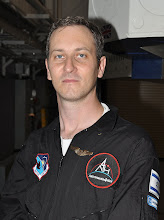
A veteran software innovator, family man, amateur photographer, violinist and co-founder of Astronauts4Hire on a new/old path to be involved in research and space exploration.


 Space Shuttle Launch Poll Results